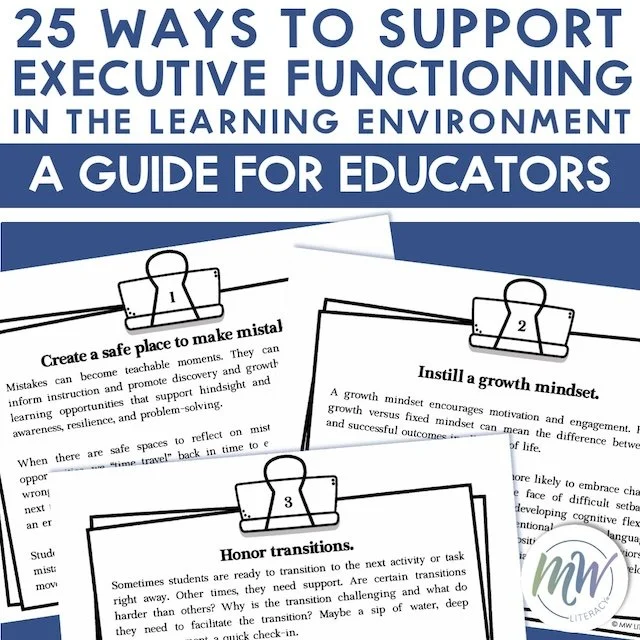
Supporting Executive Function Skills in the Learning Environment
Executive function skills are the crux of successful learning outcomes. They are an interconnected web of cognitive processes that helps us to successfully navigate everyday tasks and responsibilities, work towards academic success, and build and maintain relationship. The EF system is a management system that supports goal-directed behaviors and the foundation for successful learning.
(For a quick overview of EF Skills, grab the FREE Handout.)
Supporting these skills in the learning environment has to be a priority. There are countless ways to do this. Here are my top 5:
Avoid cognitive overload during instruction. When what we teach, or the way we teach, imposes a cognitive load, the outcomes are not as successful.
Explicitly teach how to organize spaces. For many students, telling them to “clean up” works. For many others, they may move things around, but struggle with getting from Point A to Point B without explicit instruction and practice.
Increase self-awareness with the use of reflexive questioning. Instead of dead end commits, ask specific questions to encourage reflection and increase students’ own awareness of their learning.
Create a safe place to make mistakes. Safe places to make and reflect on mistakes support hindsight, foresight, self-awareness, resilience, and problem-solving.
Teach self-advocacy skills. When students learn to advocate for themselves, they are more likely to find success both in and out of the classroom.
Time can be a significant factor in building an EF-friendly learning space, but the time spent is well-worth it.
If you are looking for more actionable steps you can take to support executive functioning in your learning environment, check out this resource to get you started today.